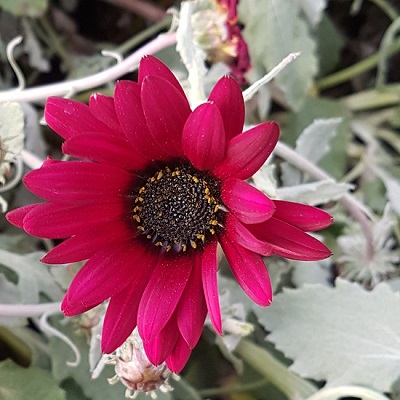
Arctotis Burgundy, also known as African Daisy ‘Burgundy’, is a low-growing, spreading perennial prized for its vibrant, daisy-like flowers in a rich burgundy color. These flowers typically bloom from spring through autumn, offering a long season of interest. The plant features grey-green foliage that provides a beautiful contrast to the striking blooms. It’s a hardy and relatively low-maintenance plant, well-suited for various garden settings and is particularly effective as groundcover or in borders.
Arctotis Burgundy boasts large, daisy-like flowers in a deep, wine-red or burgundy color. The flowers typically close at night and may only partially open on cloudy days.
Foliage:
The foliage is a contrasting grey-green, providing a lovely backdrop to the vibrant blooms. The leaves are often described as silvery-green and finely cut.
Growth Habit:
This plant has a low-growing, spreading habit, typically reaching a height of 30-40cm and a width of 50-100cm.
Flowering Season:
Arctotis Burgundy flowers prolifically from late spring through autumn, and in warmer climates, it may continue blooming into the fall after a summer break.
Sunlight and Soil:
It thrives in full sun and well-drained soil.
Hardiness:
Arctotis Burgundy is generally hardy to USDA zones 9-11, and it can be grown as an annual in cooler regions.
Care:
This plant is relatively low-maintenance, requiring regular deadheading of spent flowers to encourage more blooms. It is also drought-tolerant once established.
Uses:
Arctotis Burgundy is a versatile plant, suitable for various garden applications, including borders, rock gardens, mass plantings, groundcover, and coastal gardens. It can also be used to brighten up dull corners or planted along paths and borders.
Arctotis Burgundy, also known as African Daisy, is a relatively low-maintenance plant that thrives in sunny locations with well-drained soil. It is known for its wine-red, daisy-like flowers and grey-green foliage, and is tolerant of dry conditions, coastal environments, and moderate frosts.
Cultivation Details:
Sunlight: Arctotis Burgundy needs full sun for optimal flowering.
Soil: Well-drained soil is essential, and it can tolerate a range of soil types, including slightly sandy soil.
Watering: Water thoroughly after planting, but once established, it is drought-tolerant and needs only occasional watering.
Fertilizing: A slow-release granular fertilizer can be applied in spring to encourage growth and flowering, but avoid high-nitrogen fertilizers.
Propagation: Arctotis Burgundy can be propagated from seeds, seedlings, or cuttings.
Pruning: Deadheading spent flowers will encourage further blooming.
Location: It is suitable for mass planting as groundcover, along borders, or in coastal gardens.
Arctotis Burgundy should perform well, especially in sunny, well-drained spots. It’s adaptable to coastal conditions and moderate frosts, which are common in New Zealand.
Key Considerations:
Frost Tolerance:
While Arctotis Burgundy is moderately frost-tolerant, ensure it is planted in a location that provides some protection from severe frosts, especially during the initial establishment phase.
Soil Drainage:
Ensure the soil drains well, as waterlogging can lead to root rot.
Wind Tolerance:
Arctotis Burgundy is tolerant of some wind, making it suitable for exposed locations, but consider planting it in a sheltered spot if strong winds are a persistent issue.
Flowering Time:
Expect the main flowering period to be in late winter and early spring, though it can continue longer with regular deadheading.