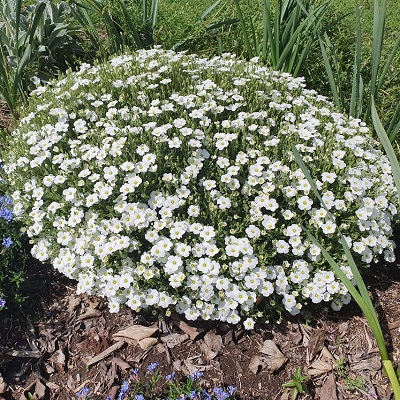
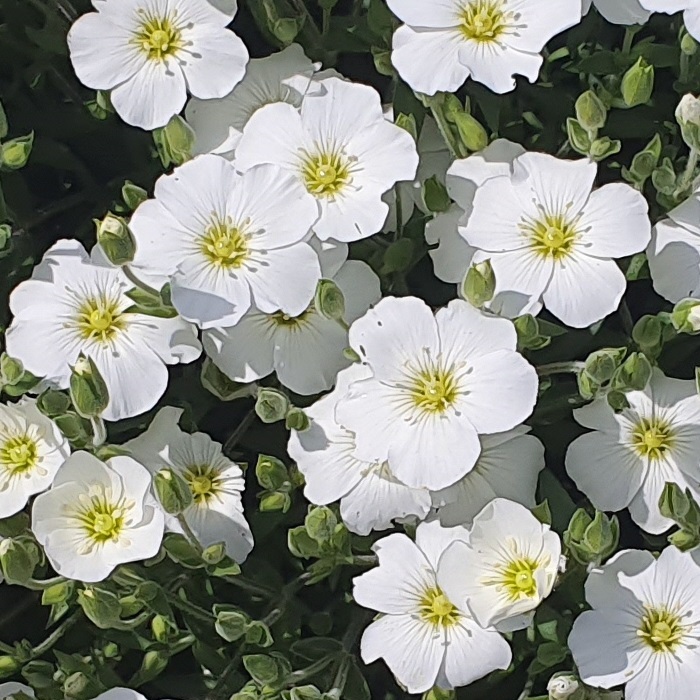
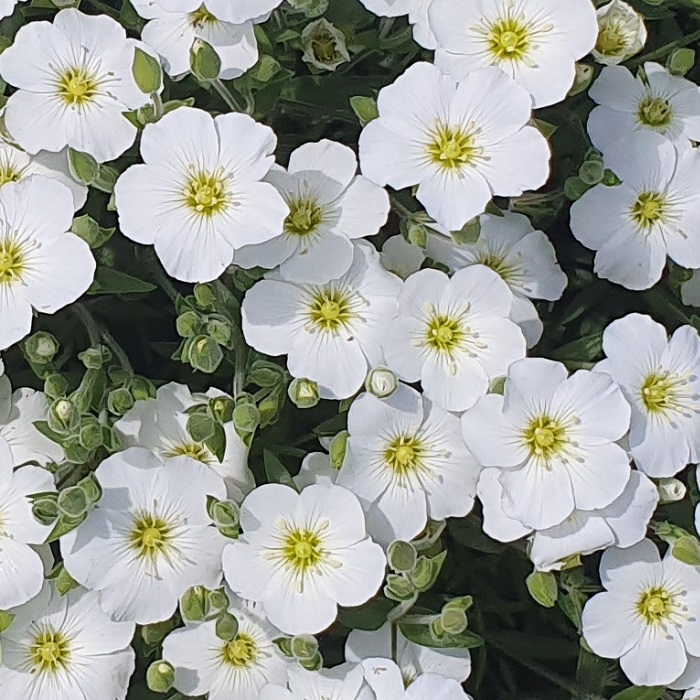
Arenaria montana ‘Avalanche’, also known as Mountain Sandwort, is a low-growing, evergreen perennial that forms a dense mat of green foliage, covered in a profusion of white, star-shaped flowers in late spring and early summer. It’s a compact cultivar, known for its neat growth habit and prolific blooming, making it a popular choice for groundcover, rock gardens, and borders.
‘Avalanche’ forms a low, spreading mat, making it ideal for groundcover. It typically reaches a height of 10-20cm and spreads to 30cm or more.
Foliage:
The leaves are small, dark green, and evergreen, providing year-round interest.
Flowers:
The most striking feature of ‘Avalanche’ is its abundance of pure white, star-shaped flowers. These flowers appear in late spring and early summer, completely covering the plant and creating a stunning display.
Light and Soil:
It prefers a location with full sun to partial shade and well-drained soil. It’s relatively drought-tolerant once established.
Uses:
‘Avalanche’ is versatile and can be used in various garden settings, including rock gardens, borders, between flagstones, in containers, and as edging.
Maintenance:
It’s low-maintenance and generally requires little pruning. A light trim after flowering can help maintain its compact shape.
Hardiness:
It’s generally considered hardy and can tolerate a range of temperatures.
Other Names:
It is also known as Snow White or Mountain Sandwort.
Arenaria montana ‘Avalanche’, commonly known as Mountain Sandwort, is a low-growing, evergreen perennial that thrives in well-drained soil and full sun to partial shade. It is relatively low-maintenance, requiring minimal pruning. It is tolerant of moderate frost and short periods of drought once established.
Cultivation Details:
Soil:
Prefers well-drained, sandy soil, but can tolerate various soil types as long as drainage is good. Avoid waterlogging, especially in containers.
Sunlight:
Full sun to partial shade is ideal.
Watering:
Water regularly during dry periods, especially in summer, ensuring the water reaches the roots and not just the surface.
Fertilizing:
A light application of balanced, slow-release fertilizer in early spring can be beneficial, but avoid over-fertilizing.
Mulching:
Mulching around the base of the plant with organic matter like Living Earth More than Mulch can help retain moisture and suppress weeds.
Pruning:
Minimal pruning is needed, but a light trim after flowering can help maintain shape.
Pest and Disease:
Generally pest and disease-free, but keep an eye out for slugs and snails, especially in damp areas. Root rot can be an issue in poorly drained soils.
Uses:
Excellent for rock gardens, borders, between stepping stones, or as ground cover. It can also be used to trail down walls or from containers.